Friday, October 25, 2013

Bali: One Bad Day in Paradise


Bali is as awe-inspiring as ever, even though traffic and tourism have grown MUCH bigger and badder since we were last there in 1996. Still, it was not hard, we discovered, to forsake the whining motor scooters for the solace of rice fields, temples, and quiet family compounds.


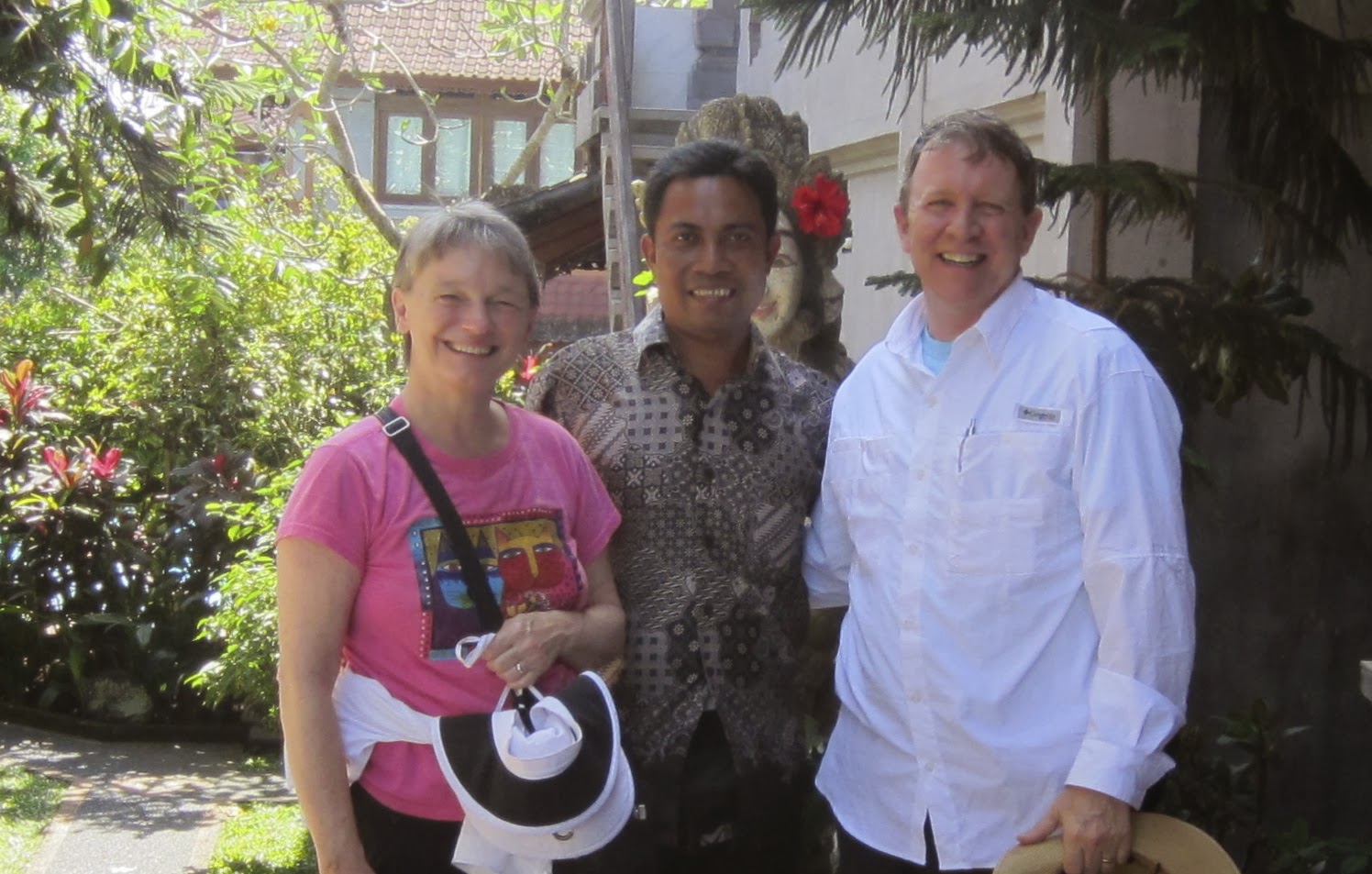
It was doubly delightful for Jan and me to share our re-experience of the island with our midwife friend, Elizabeth Walters (who was visiting Bali for the first time). 


Our guide and driver, Ida Bagus Oka, did much to help us encounter the “real Bali” we sought. He had taught (math, science, music and badminton) for 30 years at the primary school (grades 1-8) on Monkey Forest Road (just across from the soccer field). Recently retired with a government pension, this Bali Brahmin decided that driving a taxi and introducing selected foreigners to his culture would be a good way to continue supporting the adopted children he has been putting through school for decades. Even as my “transport” payments helped Ida, Ida helped me meet a suling (bamboo flute) player and maker; he also found me a saxophone and took me out to jam with two excellent bands in Ubud.


On our last evenings in Bali (as detailed in a previous blog), Ida arranged for all of us to meet the musical Prince Chok Wa of Ubud. During our stay in Bali Ida also facilitated our participation in a “touching the earth” baby ceremony (See Jan's HUG blog), helped us purchase and wear proper “Balinese costumes” in order to receive blessings at several temples, took us to all “the best” performances and arts outlets, and even brought us to his home for a special “smoked chicken” dinner our last night there. 
  

Of the sixty days Jan and I spent in Bali, only one was a disappointment—and this one was doubly or triply disappointing. Fortunately for them, Jan and Elizabeth chose to opt out of the adventure that went awry for me, in order to spend a restful evening poolside with gin and tonics.  The sad story starts with Ida’s enthusiasm for my seeing only “the best” aspects of Balinese culture. The Kecak Dance is perhaps most emblematic of all the Balinese performing arts. Accompanied only by their voices and bodies, Kecak dancers dramatize the rescue of Sita by Lord Hanumon and his monkey allies. Ida said I must go to Uluwatu to see “the best” Kecak Dance, not only because this was an entirely professional company but also because of the setting. In Uluwatu the backdrop to the performance area is the setting sun, a device that figures prominently in the story itself.


The traffic to Uluwatu was particularly snarled that Sunday. Road construction was underway near the new airport. That slowed us down. So did an extra-large number of tourist buses—all headed for Uluwatu. We had not purchased tickets in advance. In retrospect, we should have. A simple dinner in the village took longer than anticipated.


We were running late. Ida had prepared and brought offerings so that we might visit the beautiful seaside temple prior to the performance. As it turned out, the main temple area was under renovation. We did meet a priest, and he did bless our offerings and us, but it was in a rather unattractive side precinct, without the famous sea view. Hurrying next to the ticket booth, we were told upon arrival that tonight’s performance had been completely sold out. No Kecak Dance for Ida and me, even though we could see and hear it from a distance. Trying to salvage a sinking situation, Ida suggested that we proceed to the cliffside sea walk to take in the setting sun.


The sunset was, indeed, magnificent, as were the temple profiles, the color on the sea, and the silhouettes of the monkeys (long-tailed macaques, Macaca fascicuiaris) that walked along the top of the wall—as their human imitators danced and chattered, in staccato syncopation, a few hundred meters away. Trying to make the most of a sad situation, I snapped a few photos of monkeys. They were great photos, some of the best I had taken on our trip. Sitting down on the wall next to Ida, I was looking through my camera to show him a shot or two. 

On my other side I felt a monkey approach, but I knew enough not to look him in the eye. After I showed Ida the photos, I glanced back to see if the monkey was still there. He was—and in the blink of an eye he deftly removed my glasses and scampered, chattering with glee, down the wall, onto the roof of a pavilion, and then up to a higher roof still.  I was pissed.


These glasses were expensive, prescription lenses (with UV coating) and fancy, titanium frames. Elizabeth had just brought me this new pair, after I had lost them in Hawaii when I was blind-sided by a wave. I shouted and ran after the feral offender. An older couple stopped me, and said they would handle things. Ida explained that they were the “monkey police.” They began rolling fruit up the roof to the monkey, trying to bribe him into giving up the stolen goods. I had to pee, so I left, doubting I would see my glasses again. As I emerged from the Gents’, the monkey policeman handed me my glasses. They were twisted and scratched, with chewed up nose pads. “Wait. I will clean them!” the man said, beaming with the glow of his success. “Give him 50,000 [$5],” Ida said. I had my glasses back, but they were useless.


I had not seen the Kecak Dance. The temple was much less than advertised. It was a long drive back to Ubud. We tried the new “bypass,” which had just opened—but because it was toll-free for just one more day, the new “quick” route was jammed. Bumper to bumper. Ida was quiet. I was quieter. When I got home, I told Jan and Elizabeth the story of my stolen glasses. Jan rolled her eyes and claimed not believe me. I think that Elizabeth did; at least, she laughed! I had to call Jonathan and David (who remembered how intimidating monkeys could be) and my friend Dave Smith (who, as Jan knows, has a trusty nose for bullshit), to tell them all the story before Jan would believe I was telling the truth. As I said, this was an expensive pair of glasses. That monkey had busted our budget. Now I can only hope that my optometrist’s office (staffed by former students Dr. Aaron Rosenstein and Tim Barco) will also believe my tale of woe, and do what they can to restore the glasses they already kindly replaced and shipped for me once on this trip!


Thursday, October 17, 2013

Bali: “The Greenest School on Earth”


The largest bamboo buildings IN THE WORLD are the most striking characteristic of The Green School campus in Ubud. This K-12 “school in the jungle” (current student population 333) meets 70% of its energy demand on site (from solar collectors and a hydro-electric Vortex),
grows most of its own food, exclusively employs composting toilets and banana leaf food service plates, and attracts a talented international staff of 30 lead teachers and administrators.


The founding visionary of The Green School is a dyslexic jewelry maker from Canada named John Hardy. 

The Green School is now six years old and celebrated its first graduating class this past June. The curriculum emphasizes sustainability, independent and creative thinking, and cooperative, practical learning. Its calendar and structure are based on North American models, and it has begun a small boarding unit (across a covered bridge, made of bamboo, naturally). Tuition is about $10K, and the school aspires to draw 20% of its student body from “local” Balinese and Indonesian families. Its primary language of instruction is English, but Bahasa Indonesia is also taught and widely spoken on campus. Because foreigners cannot own land on Bali, the school operates with a long-term lease from an ancient and prominent local family.


Becoming “the greenest school on earth”  was certainly an honor and a hard-earned achievement. Nevertheless, it must be said that Bali is an ideal location for green living. A temperate tropical climate, abundant supplies of water and renewable building materials, insects that are readily amenable to biological control, and great volcanic soil give The Green School advantages that few other schools can match. Having said that, though, their model is inspiring, and their commitment to purpose is compelling.


The “green school” or “eco-schools” movement is an international enterprise. At CFS the "Building Friends" campaign includes a laudable emphasis on sustainability. The Afghan Sister School relationship is a beacon of love and devotion in a world of strife. Perhaps CFS might wish to broaden and strengthen these initiatives by forging other partnerships with like-minded school communities. The Green School, Ubud, might be one place to start.


Another potential partner is the Dyatmika School in Denpasar, where the architecture may not be so stunning but where the curriculum, staff, and school climate may be even better developed, sturdier, and more sustainable.


Monday, October 7, 2013

Bali: The Son of the King, and I


The great Rodgers and Hammerstein musical, The King and I (1951-56), was based on the true story of Anna Leonowens, a British teacher who in the early 1860s served as governess to the children of King Mongkut of Siam. It is one of my favorite musicals, so imagine my surprise when, towards the end of our stay in Bali, I had the chance to become the saxophone teacher of the youngest son of the King of Ubud, Bali—and then heard the music of Ariel’s Way playing in a setting that is truly palatial!


Chokorda Ngura Sulyadnya (“Chok Wa” for short) is a warm and hospitable person with a remarkable passion for the arts. Though the royal family of Ubud no longer has political power, it continues to perform important ceremonial functions.

Furthermore, Chok Wa (who serves as head of security and emergency management in Ubud) has demonstrated, for years, an unwavering commitment to preserving Ubud’s cultural traditions (especially music, dance, and stone carving). He himself dismisses his own talents as an artist, but he clearly has a deep grounding in all the cultural traditions he seeks to promote. I watched him coach young gangsa players, heard him sing parts to other musicians, and saw the shapes that his imagination designed in the architecture of his residence.

Six years ago Chok Wa began work on a performing arts center that would showcase the culture of Ubud. He now sponsors five different gamelan groups (including a women’s group and several children’s group—whose names all include the royal initials “CW”). The facility he’s constructing can present Balinese music and dance in a sumptuous setting, featuring rice-terrace views, a lushly landscaped courtyard, and (eventually) accommodation for artists-in-residence in a peaceful but awe-inspiring setting.


Our Balinese teacher and driver, Ida Bagus Oka, found me a saxophone to play and took me out several times to hear (and to sit in with) local Ubud groups. I was impressed with the talent of the musicians I heard, and news of my presence in Ubud apparently came to Chok Wa’s attention. He asked Ida to bring me by so that I might help him learn more about the saxophone.

Walking into Chok Wa’s “palace in progress” was truly breathtaking. A sixty-foot high, intricately carved, truncated pyramid stands above the main gate, beautifully lit for evening. A half dozen waterfalls drop thirty feet or more into pools and streams that course through the golf-green courtyard. A young people’s gamelan, about 40 strong (under the supervision of four or five adult teachers), were working on a gong kebyar piece that was both challenging and powerful. Other gamelan students rehearsed in another pavilion. Sitting barefoot on the marble floor of the main pavilion, and sighting down a staircase trimmed with a pair of stone dragons, I tried to take it all in.


After the students had gone, Chok Wa, Ida and I (plus an attendant or two) admired the ALL WOOD saxophone that Chok Wa owned. I played it briefly to confirm that it did in fact play. He asked me then to play “my” horn, which I did. Then Chok Wa called for his own Conn-Selmer “Prelude” alto. He wanted me to teach him about it. He was a serious, focused student throughout a lesson that lasted nearly an hour. Chok Wa videotaped me, as I myself had done several days before when my suling (Balinese bamboo flute) teacher showed me about circular breathing and how to finger the pelog scale. Chok Wa was interested in the mouthpiece and reed, the embouchure, and the chromatic fingering. By the end of our hour together, he was able to play two octaves of a C major scale—much more progress than beginners typically make.


Before leaving, Chok Wa took me into his living quarters—which were truly fit for a king. Sitting together, we jammed on a steel drum and some similarly tuned propane canisters, and ended in a perfect moment of harmony. I saw his orchid collection and even the bathroom, which included mirrors trimmed with hand-painted flames. Ida could not believe that we had been permitted such an intimate glimpse into royal life. His children’s rooms were down a hallway that we did not enter.


The next night, our last in Bali, Chok Wa invited Jan, Elizabeth (our midwife friend who had come to visit) and me to dinner; however, we already had an invitation to eat with Ida and his family. But we did drop by the Prince’s place once more. Jan and Elizabeth had to see it for themselves, and I wanted to give Chok Wa a gift.

This time, he asked me to stand in the doorway to his apartment and play the wooden saxophone for the gamelan players who had stayed to hear. I did not have any time to warm up, and the horn was not as responsive as I would have liked, but still it was a beautiful moment. “Somewhere Over the Rainbow” seemed like a good choice. This certainly wasn’t Kansas!


I presented Chok Wa with my Ariel’s Way CD/DVD set, and he promptly put it on his sound system. Hearing the songs resounding in this superb courtyard setting on this magical island was almost as amazing as seeing the show for the first time. A dream I had dared to dream really had come true!


After presenting me with his gift—his own suling—Chok Wa escorted the three of us out, across the dazzling aquarium beneath the doorway to his compound. Did I see Elizabeth deliberately slip so that the handsome prince could support her? Generous and kind to the end, Chok Wa invited us to come back next time, when his palatial arts center was finished, and be his guests, for some “musical collaborations.” How can I refuse?


Friday, October 4, 2013

Bali: Visiting the “Temple of Business”

Bali is a land of temples. Every family compound has one, facing Mount Agung (in the northeast corner of the compound, if you live in the Ubud area). Every Balinese village also has at least three temples, dedicated to Brahma, Vishnu, and Shiva. (The local cemetery, where corpses are laid to rest until they can be cremated, is located near the latter temple.) Every Balinese school has its own temple too, as well as a beautiful statue of Saraswati (the patron goddess of learning and the arts). Special calendars in every shop and home show the overlap between the many festivals prescribed on the traditional lunar calendar and the days when those celebrations fall on the solar calendar that the modern world agrees to use.


Because divine forces interact with every aspect of Balinese life, it is no surprise that economic enterprises come under the scrutiny of the gods (and of the priests, whose prayers and rites maintain right relations between heaven and earth). Pemuteran, a town on the northwest coast of Bali, is a center of world-class snorkeling and scuba driving today. It is also home to a Temple of Business, Pura Melanting, which dates back to the fifteenth century (a full century before the first contact between the Balinese and the Dutch, who eventually colonized the island, by force of arms, in the Western style of doing business).


Our Balinese teacher and guide, Ida Bagus Oka, thought it would be very appropriate for us to pay a visit to this Temple of Trade (or Business). Jan had told him of her HUG Your Baby work, and I had told him about Ariel’s Way. Our view is that these “businesses” are more vocations, or spiritual pursuits, than money-making enterprises. And our American midwife friend, Elizabeth Walters, felt the same way about her work as a healer and her daughter Erin’s work as an artist and entrepreneur in New Orleans.


Too many steps to climb at Melanting meant that Jan had to pass on this temple visit, but Elizabeth and I set off with Ida, wearing our hastily purchased (but, thanks to Ida, properly worn) “Balinese costumes.” We met the administrator of the temple near the entrance, signed the guest book and gave a small monetary gift towards temple upkeep. We then purchased incense and offerings to take to the priest. Quite a bit of climbing was required, and several handsomely carved portals were passed through on the way up. Thanks to Elizabeth for serving as event photographer!


Inside the highest courtyard Elizabeth and I followed Ida in praying to the sun god, the local god, and all gods. We were purified by the priest with holy water, and then offered our gifts (and business cards) as the priest chanted in Sanskrit. Then (while the priest casually smoked a cigarette) we earnestly and silently prayed that the work we love might be a vehicle for divine energy and will. Ida, a retired school teacher and a member of the Brahmin caste, was a very patient guide and interpreter on this occasion (and on many others during our stay in Bali).


Like centuries of Balinese farmers and traders before us, we came down, literally from the clouds, refreshed with holy water and purified in our intentions to do good with our work in the world. Everything in Bali holds the promise of divine participation, and Elizabeth, Jan and I were grateful for this special chance to harmonize the business interests we love with the spiritual powers that animate every aspect of Balinese culture.